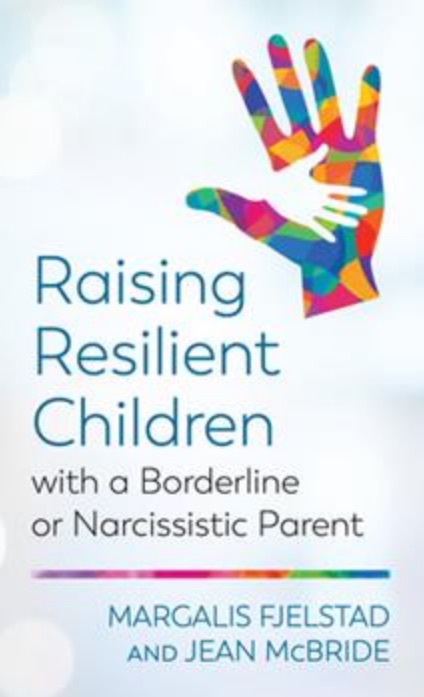
 |  | Raising Resilient Children with a Borderline or Narcissistic Parent
Author: Margalis Fjelstad, PhD, Jean McBride, MS, LMFT
Publisher: Rowman & Littlefield Publishers, 2020
Paperback: 227 pages
ISBN-10: 1538127636
ISBN-13: 978-1538127636

|
Book Review:My narrowest niche interest is Borderline Mothers of Young Children - not in the sense of "Now that I'm an adult I think my mother had BPD", but in the sense of "A BPD has young children, what now?". There are not many books on that topic, since those actually diagnosed with Borderline Personality are often...not very involved in childrearing. Two months after I spoke in an official capacity about Dr. Christine Lawson's superb "Understanding the Borderline Mother" (
https://bpdfamily.com/message_board/index.php?topic=53779.60) and noted that it was the definitive work on the subject, a new book was published - "Raising Resilient Children with a Borderline or Narcissistic Parent". Needless to say it was immediately ordered to the home.
Unfortunately the book is not great; two major problems:
1) Two therapists with disparate interests wrote a joint book that covers neither topic in sufficient detail. In places they appear to blur the line by suggesting that they mean the narcissistic traits of a pwBPD rather than anything to do with NPD (despite the title).
2) To make the book of wider appeal, they do not focus only on those patients who are diagnosed or meet the diagnostic criteria for Borderline Personality Disorder, but rather speak broadly of "those with Borderline traits", even when they only possess one or two of the traits. (For context, I'm speaking as a reader whose nearest diagnosed pwBPD has 9/9, and nobody has BPD without at least 5/9)
The book doesn't offer much new insight into BPD, instead quoting Dr. Lawson's "Understanding..." and mixing it together with the newer emphasis on Linehan's DBT (as is seemingly necessary to get any BPD book published post-2010, though I skeptically maintain there's an element of letting the inmates run the asylum).
It doesn't touch on the morbid comorbidity between BPD parents and filicidal parents that Lawson addresses in some detail, but it does reference the increased suicide risk of children under the age of 10 being raised with a pwBPD in the household.
One major strength it has is recognizing that "
to parent effectively with [pwBPD partner] is not intuitive. It often requires you to act very differently than you would expect to interact in a normal relationship. You can't always follow the typical advice of marriage counselors or parenting experts...most therapists have had little or no training to deal with a couple where one has a [pwBPD partner]. As a result, many of the suggestions and directions you'll get from these therapy sessions will be unhelpful and may actually be damaging. Most couples' therapy will on the two of you communicating better, sharing your feelings and paying more attention to each other but these suggestions can easily be used by the [pwBPD partner] to demand more and more agreement and attention from you which can make your relationship worse for you while not making any changes in your dysfunctional family system", etc.
Interestingly, the two authors' voices are not distinguished but it's relatively easy to separate their processes as one seems to ultimately conclude that it is necessary to divorce a pwBPD and have the non-BPD raise the children with as little interference as possible, while the other clings more to the "There's always hope! Never give up! Miracles happen everyday!" attitude commonly seem in DBT which was, after all, entirely written by a person who has BPD themselves).
For those like me who care, it is sufficiently but not greatly footnoted, and has a decent index. For those bibliophiles following my latest conspiracy theory, it further cements my suspicion that books that start each chapter with a blank title page are feel-good Kornfieldesque tripe and likely to disappoint





 Poll
Poll